dal
18
Marzo
Flowers. Wonderful Nature
18 Marzo 2026 / 06 Settembre 2026
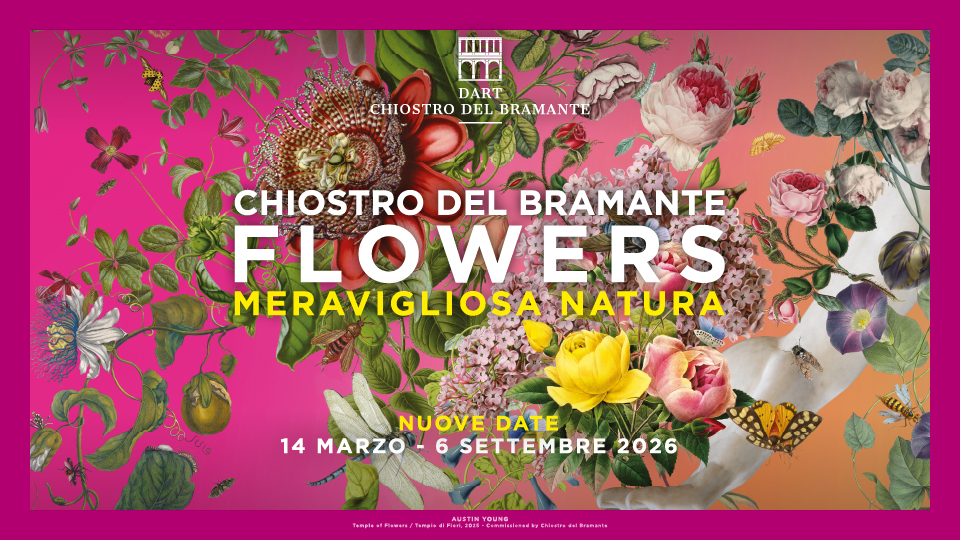
“Flowers. Wonderful Nature”: at Chiostro del Bramante
from 18 March to 6 September 2026
In continuity with Flowers. From the Renaissance to Artificial Intelligence, while remaining an independent initiative, the exhibition evolves and broadens its perspective. While in the first chapter the flower was at the centre of the reflection as a symbolic, political and poetic element, Flowers. Wonderful Nature now turns to nature in its entiret. A Nature understood as an organic and ever-changing universe in which plant and animal forms, marine elements and multiplespecies coexist and engage in dynamic balance.
The exhibition features a reworking and expansion of its scientific content, enriched by the addition of important new loans from prestigious Italian collections, including the Biblioteca Casanatense, the Medici Villa at Poggio a Caiano, Museum of Still Life, the Pinacoteca Tosio Martinengo in Brescia and the Civic Museum of Zoology in Rome. This collaboration highlights the role of public, civic and state collections as custodians of a heritage of extraordinary historical, artistic and scientific importance.
Three macro-sections for interpreting the present through nature
The exhibition is structured around three macro-sections — Art and Ecology, Art and Science, Art and Politics — offering a journey in which historical and contemporary works enter into dialogue through a continuous interplay of references, connections and suggestions. The exhibition brings together Italian and international artists and presents works ranging from the seventeenth century to the present day, including works created using the latest technologies and artificial intelligence, testifying to an ongoing dialogue between tradition and innovation.
Returning highlights, and new works that expand the narrative
Visitors will rediscover some of the highlights of the first chapter, such as the site-specific installations by Austin Young and Zadok Ben-David, alongside new works by artists already featured in the previous edition — including Zadok Ben-David himself and Tamiko Thiel and /p — offering deeper insight into their language and artistic research. The Flowers. Wonderful Nature itinerary is enriched by new additions and scientific content: thanks to major loans from the Civic Museum of Zoology of Rome and the Capitoline Superintendence, visitors will be able to admire the diorama dedicated to the Oceans and the Bavarian Forest, in dialogue with new contemporary works and installations — including Enter the Plastocene by Tamiko Thiel and /p and Sunday’s lunch 02 by Eugenio Tibaldi — as well as seventeenth- and eighteenth-century works by Margherita Caffi, Filippo Teodoro di Liagno, known as Filippo Napoletano, and Pietro Neri Scacciati. New loans by Tracey Bush, Rob and Nick Carter, Ann Carrington, and a previously unseen group of works by Zadok Ben-David complete the narrative, broadening the reflection on biodiversity, the fragility of ecosystems and collective responsibility. An exhibition that, like a living organism, continues to evolve, transform and surprise.
Activities for children
In Flowers. Wonderful Nature, special attention is given to families and younger visitors, with tools designed to make the visit accessible and shared. The exhibition includes a children’s route, with captions placed at a height suitable for children and conceived for shared reading by adults and children.
One room in the exhibition is dedicated to experimentation and play: here children, under adult supervision, can freely reinterpret their visit by creating special flowers, conceived as lenses through which to observe the world, using the materials provided. An activity that invites them to imagine, explore and discover new ways of looking at nature together. The Education Department also offers activities for schools, children, families and adults, summer programmes, and inclusive visits by reservation, including LIS and tactile tours.